#ArtisticAnatomy
This note mainly covers the main back muscle structures and their layering relationships. The reference material is still Anatomy for the Artist by Uldis Zariņš et al. (published by China Industry & Information Technology Publishing Group and Publishing House of Electronics Industry).
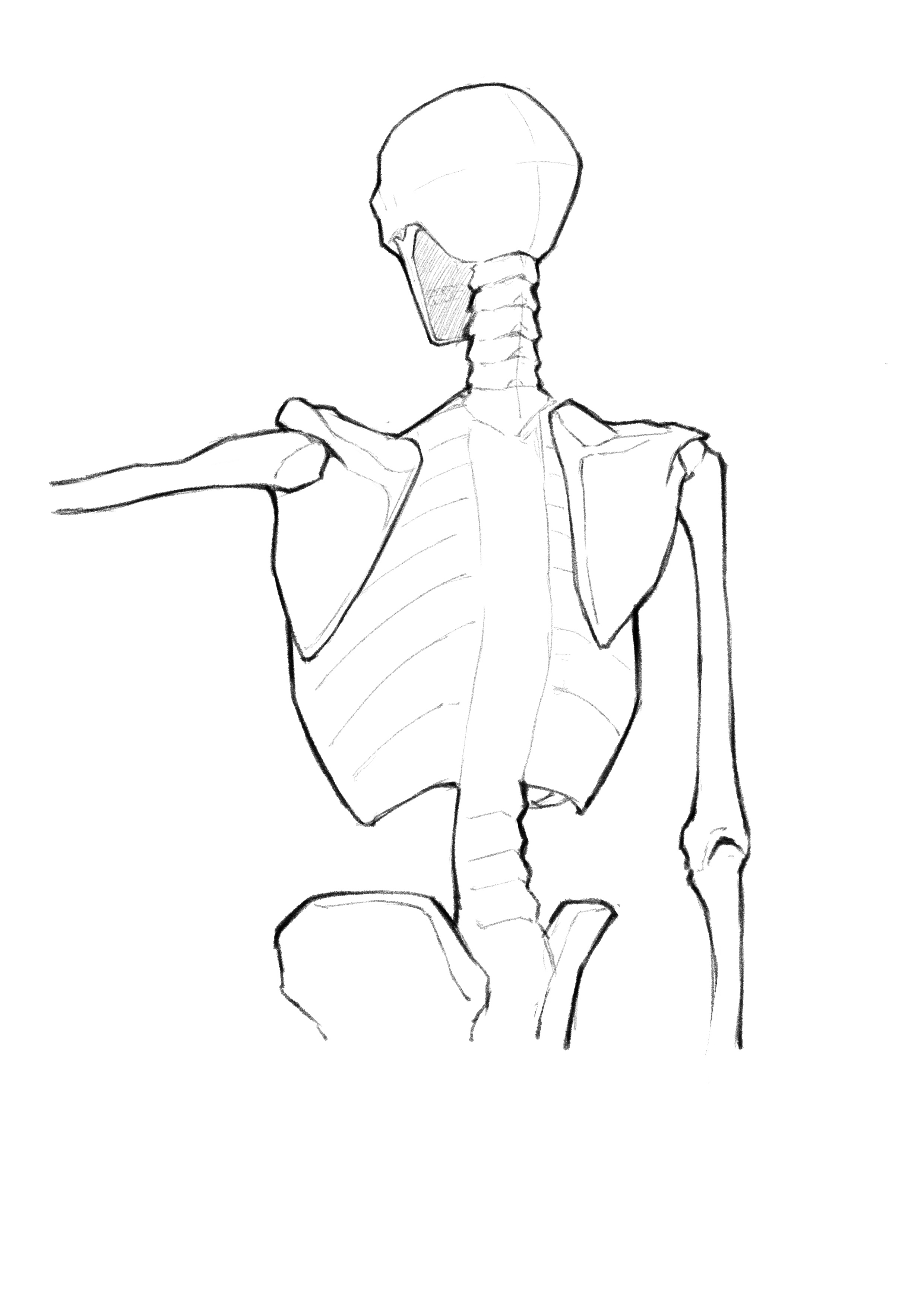
The skeleton used is shown in the figure below. Since the specific distribution and count of ribs and vertebrae are not very helpful for memorizing the main muscles—and are rarely useful except in very hardcore drawing scenarios—the ribs (thoracic cage) and spine are represented with simplified shapes in this note.
Serratus Anterior
As shown in the figure, when viewed from the back it is largely covered below the scapula; the undulations of the serratus anterior can be observed from the sides. For lean or muscular people, the distinct serrated appearance of the serratus anterior can be observed on the body surface (from the sides).
External Obliques
The external obliques originate from the back of the ribs, so part of them can be seen even from behind.
Teres Major & Teres Minor
Both the teres major and teres minor are muscles connecting the scapula and humerus; their layering relationship is shown in the figure below. Note the positions where each connects to the humerus. In practice, the teres minor is difficult to observe on the body surface due to coverage by the infraspinatus and deltoid, but it can still be clearly seen from certain angles.