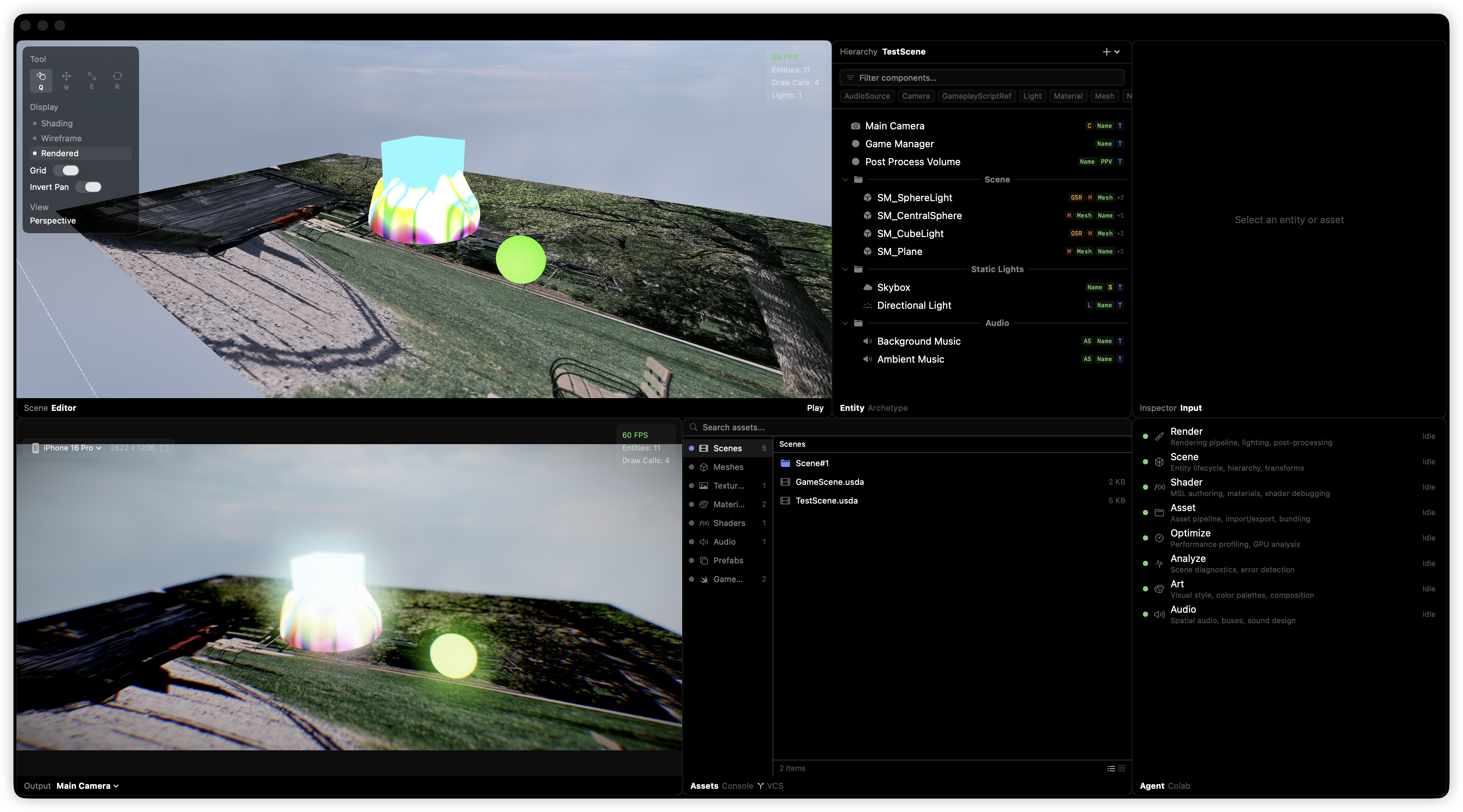
Metal Caster is my attempt to rethink game engine design for the Apple ecosystem from first principles.
Instead of building a general-purpose engine for every platform and every workflow, Metal Caster is intentionally opinionated: Swift + SwiftUI + Metal + ECS, Apple platforms only, and AI as a first-class interface to the engine.
The engine is open source and can be accessed through GitHub.
Why I Started This
Most engines optimize for flexibility and cross-platform scale.
Metal Caster optimizes for something else:
- Better defaults over endless configuration
- Deep Apple Silicon optimization over portability
- AI-native creation workflows over manual boilerplate
- Visual clarity and tool elegance over feature bloat
The core idea is simple:
Describe what you want -> AI builds it through engine tools -> refine visually in the editor.
I want the engine to feel like a precision instrument: focused, minimal, and fast.
Engine Architecture
Metal Caster is organized as a Swift Package with ten library modules and two executables — roughly 63k lines of Swift across the engine, editor, and tooling:
| Module | Responsibility |
|---|---|
MetalCasterMath | Vectors, matrices, quaternions, AABB/OBB/frustum, ray-primitive intersection (Möller-Trumbore, slab tests, SAT), splines |
MetalCasterCore | ECS world, engine loop, event bus, profiler |
MetalCasterRenderer | Metal abstraction, render graph, shader compilation & caching, PBR materials, post-processing |
MetalCasterScene | Scene graph, USD import, camera/light/mesh systems, light & reflection probes |
MetalCasterAsset | Asset pipeline, MSL → .metallib precompilation, texture compression, .mcbundle |
MetalCasterAI | Multi-provider LLM layer, 9 specialist agents, orchestrator, engine snapshots |
MetalCasterPhysics | Rigid bodies, sort-and-sweep broadphase, CPU raycasting against colliders |
MetalCasterAudio / Input | Spatial audio, cross-platform input abstraction |
The Rendering Stack
This is where most of my recent work has gone. The renderer is built around a render graph that sequences mixed render and compute passes, with two selectable render paths:
- Forward path — Shadow → Skybox → Mesh + Lighting → Post-Process → Blit
- Deferred path — Shadow → G-Buffer (MRT) → screen-space deferred PBR lighting → Skybox → Post-Process
The G-Buffer packs albedo+metallic (RGBA8 sRGB), normal+roughness (RGBA16F), and world position (RGBA32F) alongside a Depth32F target.
Physically based shading
The core material model is Cook-Torrance: GGX normal distribution, Smith geometry term, and Fresnel-Schlick, driven by metallic/roughness material properties and textures. The same BRDF runs in both the forward multi-light shader and the deferred lighting pass.
MSLfloat3 F0 = mix(float3(0.04), albedo, metallic);
float  D  = distributionGGX(NdotH, roughness);   // GGX NDF
float  G  = geometrySmith(NdotV, NdotL, roughness);
float3 kD = (1.0 - F) * (1.0 - metallic);
Lighting & global illumination groundwork
- Shadow mapping with a dedicated depth-only pass (front-face culling + depth bias)
- Light probes storing L2 spherical harmonics, evaluated in-shader for diffuse GI
- Reflection probes with box/sphere shapes and parallax-corrected cubemap projection
- Procedural atmosphere with Rayleigh + Mie scattering, and an animated water surface with vertex displacement
Post-processing stack
A volume-based post-process chain over ping-pong HDR targets:
SSAO → Height Fog → Bloom (mip-chain downsample/upsample) → Depth of Field → Motion Blur → Panini Projection → Color Grading → Vignette / Chromatic Aberration / Film Grain → FXAA
Editor-grade GPU features
- GPU object picking: every entity is rendered with its ID into an
r32Uinttarget, giving pixel-perfect selection; the same buffer drives an edge-detected outline post effect. - GPU profiling: per-pass timestamps via
MTLCounterSampleBuffer, surfaced in the editor and consumed by the Optimize agent. - Runtime MSL compilation with a pipeline cache, so user- and agent-authored shaders hot-reload without restarting the engine.
- Compute passes power the Scene Composer's terrain tools: heightmap generation, hydraulic erosion, normal derivation, and sculpting brushes all run as Metal compute kernels.
AI as an Engine Interface
The AI system is not a chat sidebar — it is a control layer that operates the engine through the same APIs the editor uses.
- 9 specialist agents: Scene, Render, Shader, Asset, Optimize, Analyze, Art, Audio, and Composer — each with a scoped toolset (30+ tools total, e.g.
createEntity,addPostProcess,modifyShader,profileFrame,generateColorPalette). - Multi-agent orchestrator: a planner LLM decomposes a request into prioritized delegations ("create 12 building entities" → Scene; "neon-glow materials" → Shader; "colored point lights" → Render) and executes them in order.
- Snapshot-driven context: before every call, the engine serializes an EngineSnapshot — entity hierarchy, components, render state, draw calls, frame timing — so agents reason about the actual world state instead of hallucinating it.
- Tools, not code dumps: agents mutate the world through typed, fail-safe tool calls that return structured results, keeping every AI action inspectable and reversible.
- PromptScript: a compiler that turns natural-language behavior descriptions into Swift ECS components and systems, with a preview runner.
- Multi-provider: OpenAI, Anthropic, and Gemini backends behind one interface.
Tooling: Shader Canvas & SDF Canvas
Two companion tools grew out of the engine and became projects in their own right:
- Metal Shader Canvas — a standalone real-time MSL workbench with layered shader authoring and an agentic editing loop (see its dedicated page).
- SDF Canvas — a node-based signed distance field editor that generates sphere-tracing MSL: the generated fragment shader ray-marches the SDF scene, with soft shadows (64-step shadow marching) and ray-marched ambient occlusion. A "Pro" version is embedded directly in the editor.
Current Status & Honest Gaps
Metal Caster is in an active pre-alpha / architecture-hardening stage with a working vertical slice across all core systems: ECS runtime, dual-path renderer, macOS editor (multi-panel workspace, build & play workflows), asset/build pipeline, and the agent system.
Still on the roadmap, stated plainly:
- Hardware ray tracing (
MTLAccelerationStructure) and a proper GI solution beyond probes - A dedicated particle/VFX system
- Wiring the Composer agent's terrain tools and viewport spatial queries into the agent pipeline
- Broader test coverage and large-scene production hardening
Ambition
Metal Caster is not trying to be the next "everything engine."
Its ambition is more specific:
-
Become the best native engine experience on Apple platforms
iOS, macOS, tvOS, and visionOS — with Metal-first performance and Swift-native ergonomics. -
Make AI the primary creation interface
Not a chat sidebar, but a real engine control layer that can inspect state, call tools, and build scenes/materials/systems safely. -
Build a USD-native collaborative workflow
Scene data as composable, version-friendly assets for real team workflows. -
Stay open, inspectable, and performance-transparent
Clean package boundaries, measurable runtime behavior, and APIs that both humans and agents can reason about.
If successful, Metal Caster should feel like the Leica of game engines: focused, deliberate, and uncompromising in its domain.