Light & Shadow in Drawing · Part 2 of 3 · March 7, 2021
Lighting #2 Occlusion Shadows
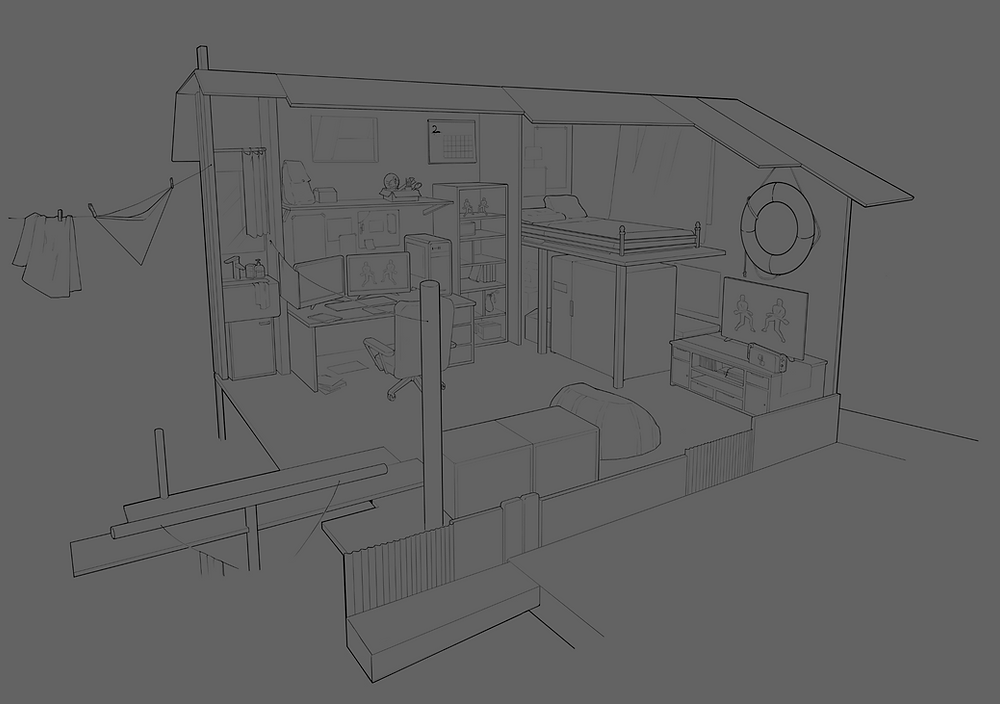
The previous note dealt with the first kind of dark — value from surface orientation. This one covers the second: occlusion.
A.O. rendering
In 3D digital rendering there is a useful technique called A.O. rendering, where A.O. stands for Ambient Occlusion. These renders usually look very white, but their shadows can be extremely deep.
For example, from the Unity documentation: https://docs.unity3d.com/Packages/com.unity.postprocessing@2.0/manual/Ambient-Occlusion.html
And another from https://vr.arvilab.com/blog/ambient-occlusion
The principle of A.O. rendering is that we assume light arrives equally from everywhere. Only the places light cannot reach show up as deep shadow.
The principle of the A.O. shadow itself is that when surfaces come close to one another they shade each other. The further apart they are, the softer the shadow; otherwise it can be as dark as black.
Note, however, that these shadows are not produced by cast light rays, so they are not cast shadows. They exist because the incoming light is being attenuated.
That distinction is important enough to spell out:
| Occlusion shadow | Cast shadow | |
|---|---|---|
| Cause | Light cannot get in | Light is blocked |
| Depends on light direction | No | Entirely |
| Location | Always in the crevice between two surfaces | On the unlit side of the occluder |
| Edge | Always soft, fading with distance | Can be very hard (near a point light) |
| When the light moves | Stays put | Moves with it |
Occlusion shadow does not disappear when you change the lighting. An overcast exterior has almost no cast shadows, yet every crevice, fold and contact point is still dark — that is pure occlusion. It is also why an overcast photograph reads as grey but still solid.
Where occlusion appears
Just ask one question: how much sky can this point see?
- Contact points: wherever two objects touch. Box meeting floor, foot meeting ground, finger against finger. These are the deepest and sharpest.
- Inner corners: wall to wall, wall to floor, the inside of a drawer, the inner wall of a cup.
- Folds and hollows: creases in cloth, either side of the nose, eye sockets, the inside of an ear, the armpit.
- Surfaces close but not touching: an arm held near the body but not against it still occludes and is occluded.
Conversely, convex forms never carry occlusion: the tip of the nose, the knee, the point of the shoulder, the knuckles. Those read as pure white in an A.O. pass.
How it falls off
The strength of occlusion depends only on distance:
- Surfaces touching → nearly black.
- Slightly apart → mid grey, the edge beginning to soften.
- Well apart → almost nothing.
So when drawing occlusion the stroke should start at the crevice and fall off quickly. The most common mistake is a dark line of even width, which reads as an outline rather than a shadow. The correct shape is darkest right at the seam, lightening within a pixel or two, then trailing off softly.
The other mistake is spreading occlusion too wide. For a ball resting on the ground, occlusion occupies only the small wedge between ball and floor; it does not extend over the lower half of the ball. That larger area is value from orientation, which belongs to the previous note.
Example 1: an interior
Again, let us take the interior and the character from the previous note.
Notice how deep the shadows become in the regions light cannot reach.
Multiplying the A.O. shadow with the greyscale surface orientations from our earlier shading step produces a more realistic interior render.
[ Before applying A.O. ]
[ After applying A.O. ]
Notice how the soft shadows are placed through the scene.
The key word here is multiply. Occlusion is not a new layer of grey; it is an attenuation of the values already there. In digital painting, use a Multiply layer; in traditional drawing, press a second layer of tone over the tone already laid in. This keeps occlusion in a lit area lighter than occlusion in a shadowed area — because occlusion reduces how much light gets in, not how dark the result is.
Use an overlay, or simply paint dark, and occlusion comes out equally black in lights and darks, and the picture loses its range immediately.
Example 2: a character
The heaviest occlusion on a figure sits in an almost fixed set of places, which can be used as a checklist:
- Where the jaw meets the neck — the deepest single point on a face
- Either side of the nose, and under it
- The eye socket under the upper lid
- Inside the ear
- The hollow above the clavicle
- Armpit, inside of the elbow, back of the knee
- Between the fingers and at their bases
- The bottom of every fold in clothing, and between clothing and body
Darken these and the figure immediately sits into the picture. None of it requires knowing where the light is.
The next note covers the third kind of dark: cast shadow.